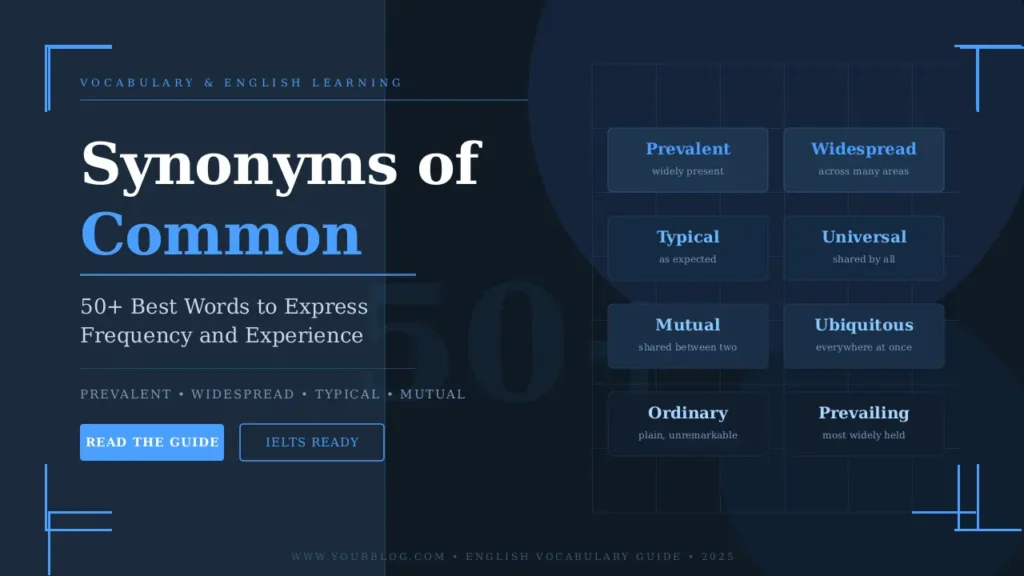

Synonyms of common are words that replace “common” depending on whether you mean something widespread, ordinary, shared, or familiar. Learning synonyms of common helps writers avoid repetition, adds depth to their vocabulary, and makes both spoken and written English feel more natural and polished. Using the right synonym of common also helps you match the tone of your message whether you are writing a formal essay, a casual blog post, or a quick email.
Think about the last time you described something as “common.” Maybe you wrote: “This is a common mistake.” Or: “They share a common interest.” Both sentences work, but they feel flat. Now imagine writing: “This is a prevalent mistake” or “They share a mutual interest.” Suddenly, the same idea carries more weight and precision.
“Precision in language is a form of respect for your reader and for your message.”
The word common can mean several things. It can describe something that happens frequently, like a common cold and it can describe something shared between people, like common ground. It can also describe something ordinary or plain, like a common dress. Because the word carries so many meanings, having a strong list of alternatives is valuable for students writing academic papers, for bloggers creating engaging content, and for everyday speakers who want to sound more confident and expressive.
“The richness of language lies not in how many words you know, but in how wisely you choose them.”
Whether you are a content writer trying to avoid keyword stuffing, a student expanding your IELTS vocabulary, or simply someone who wants to speak more vividly, this guide gives you fifty strong, ready-to-use alternatives with clear definitions and real-life examples.
What Is the Synonym for Common?
The most direct synonyms for common depend on which meaning you need. If you mean widespread or frequent, try prevalent, widespread, or universal and if you mean ordinary or unremarkable, try typical, standard, or everyday. If you mean shared between people, try mutual, joint, or collective.
Choosing the right replacement makes your writing clearer and more professional. For example:
- “A prevalent issue in schools today” sounds more formal and authoritative than “a common issue.”
- “Our mutual interest in art” sounds warmer and more personal than “our common interest.”
- “A typical response” sounds more analytical than “a common response.”
The key is to match the synonym to the specific sense of “common” you intend.
Three quick choices by context:
- Widespread — when something affects many people or places
- Mutual — when something is shared between two or more parties
- Ordinary — when something is plain or unremarkable
What Is Another Word for Most Common?
When you want to say something is the most common — that it appears more often than anything else — stronger alternatives include predominant, chief, dominant, prevailing, and principal.
These words carry a sense of ranking and frequency together. They suggest not just that something is common, but that it stands above other things in how often or how widely it occurs.
- “The predominant cause of the issue was poor planning.”
- “Fear was the prevailing emotion in the room.”
- “Their dominant language at home was Spanish.”
Three useful choices:
- Predominant — most frequent or most influential
- Prevailing — currently most common, especially in trends or opinions
- Principal — the main or primary one among several
What Is a Common Example Synonym?
A common example is a typical illustration used to clarify a point. Synonyms for “common example” in writing include typical case, standard instance, representative example, classic illustration, and usual scenario.
These phrases work well in academic writing, blog posts, and professional documents where you want to support an argument with a concrete case without sounding repetitive.
- “A classic illustration of this principle is the way children learn language.”
- “In a typical case, the patient recovers within two weeks.”
- “This is a representative example of how the policy works in practice.”
Three useful choices:
- Typical case — the most expected or average example
- Classic illustration — a well-known, widely recognized example
- Representative example — an example that accurately reflects the broader group
Were Common Synonyms?
The question “were common synonyms?” often refers to words that used to be widely used or that are considered interchangeable with “common.” Historically common synonyms include ordinary, usual, frequent, general, and standard.
These are the everyday replacements that English speakers reach for most often. They are reliable, well-understood, and appropriate across most contexts — from formal writing to casual conversation.
- “Usual practice in the office was to arrive by nine.”
- “It is standard to include a cover letter with your application.”
- “Ordinary citizens were not aware of the change.”
Three reliable alternatives:
- Usual — happening regularly or by habit
- Standard — accepted as normal or typical in a given setting
- Ordinary — plain, unremarkable, without special qualities
Synonyms of Commonly Used
“Commonly used” describes something that people rely on regularly or habitually. Strong synonyms for this phrase include widely used, frequently employed, regularly applied, broadly adopted, and standard practice.
These alternatives are especially helpful in academic, technical, and professional writing where you want to describe established tools, methods, or terms without repeating “commonly used” over and over.
- “Python is a widely used programming language among data scientists.”
- “This is a broadly adopted approach in modern marketing.”
- “The technique is frequently employed in physical therapy.”
Three strong replacements:
- Widely used — adopted across many contexts or regions
- Broadly adopted — accepted and applied by many groups or industries
- Frequently employed — used regularly as part of a process or method
Most Common Synonyms
The most useful and most frequently searched synonyms for “common” include typical, prevalent, ordinary, widespread, mutual, standard, general, frequent, familiar, and universal. These ten words appear most often as replacements because they cover the core meanings of “common” across different contexts.
Students preparing for IELTS or TOEFL exams benefit most from this group because these words appear frequently in reading passages and essay prompts.
- “Typical behavior for someone in that situation would be to seek help.”
- “The disease is prevalent in tropical regions.”
- “A sense of universal justice runs through his writing.”
Three top picks:
- Typical — matching the expected pattern or behavior
- Prevalent — widespread or commonly occurring at a particular time
- Universal — applying to or shared by everyone or everything
Synonym and Antonym of Common
Understanding both sides of a word — its synonyms and its antonyms — deepens your vocabulary significantly. Knowing the antonyms of “common” helps you describe contrast and exception more precisely.
Synonyms of common: prevalent, ordinary, typical, widespread, mutual, standard, general, frequent, familiar, everyday
Antonyms of common: rare, uncommon, extraordinary, exceptional, unique, scarce, unusual, singular, remarkable, exclusive
| Type | Examples |
| Synonyms | Prevalent, typical, widespread, mutual, standard, ordinary |
| Antonyms | Rare, exceptional, unique, unusual, extraordinary, scarce |
- “A rare opportunity — the opposite of a common one — should never be missed.”
- “Her talent was exceptional, not ordinary.”
- “Finding clean water was scarce, not widespread.”
Three antonym choices:
- Rare — occurring infrequently or in small amounts
- Exceptional — unusually good or out of the ordinary
- Unique — one of a kind, unlike anything else
Most Common Synonyms for IELTS
IELTS candidates benefit greatly from replacing overused words like “common” with more academic alternatives. The best IELTS-friendly synonyms include prevalent, widespread, typical, conventional, customary, universal, general, established, ordinary, and standard.
Using these words in your IELTS writing and speaking tasks signals vocabulary range to examiners and raises your band score. Replacing “common” with a more precise word also strengthens your argument structure.
“Vocabulary is not about memorizing lists — it is about understanding when and why each word fits.”
- “Conventional attitudes toward education are slowly changing.”
- “Customary practices in the region include early morning markets.”
- “This established method has been used in research for decades.”
Three IELTS-friendly alternatives:
- Conventional — following accepted norms or traditional practices
- Customary — established by long-standing habit or tradition
- Established — accepted and recognized as reliable or standard
Common Antonyms
The antonyms of “common” are the words you use when you want to describe something that stands out, that is hard to find, or that breaks from the norm. Key antonyms include rare, uncommon, unusual, unique, exceptional, extraordinary, scarce, singular, remarkable, and exclusive.
These words are useful when you want to emphasize that something is special or difficult to find in reviews, academic writing, storytelling, and professional reports.
- “An extraordinary leader rises above ordinary expectations.”
- “Tickets were scarce and nearly impossible to find.”
- “The coin is singular — there is no other like it in existence.”
Three antonyms to remember:
- Extraordinary — far beyond what is usual or expected
- Scarce — available in very small quantities; hard to find
- Singular — the only one of its kind; unique
Synonyms for Ordinary
“Ordinary” and “common” overlap in meaning — both describe things that are plain or without special features. Synonyms for “ordinary” (and by extension for this sense of “common”) include plain, routine, average, unremarkable, conventional, run-of-the-mill, standard, modest, middling, and nondescript.
These words are useful when you want to describe something that lacks distinction or stands below average in some way — without sounding overly harsh.
- “It was a routine Tuesday morning with nothing unusual to report.”
- “The apartment was nondescript — beige walls and plain furniture.”
- “He led an average life but was deeply content.”
Three solid synonyms:
- Routine — happening regularly as part of a standard process
- Nondescript — lacking distinctive features; unremarkable in appearance
- Average — at the middle level; neither high nor low
How Common Something Is: Synonym
When you want to describe the degree to which something is common — its level of frequency or prevalence — useful synonyms and phrases include prevalence, frequency, regularity, ubiquity, incidence, occurrence, and pervasiveness.
These words are especially useful in academic writing, health writing, journalism, and research where you want to measure or comment on how often something appears.
- “The prevalence of smartphone use among teenagers has grown rapidly.”
- “The frequency of the error suggests a deeper design problem.”
- “The ubiquity of social media has changed the way people connect.”
Three useful nouns:
- Prevalence — the state of being widespread or common at a given time
- Frequency — how often something occurs within a set period
- Ubiquity — the quality of appearing everywhere at once
Common Synonym Formal
In formal writing — academic papers, business reports, legal documents, and professional correspondence — the best formal synonyms for “common” include prevalent, customary, conventional, established, widespread, standard, predominant, routine, normative, and pervasive.
Choosing a formal synonym instead of “common” elevates the register of your writing and demonstrates academic or professional vocabulary range.
- “Normative behavior in this context includes disclosing conflicts of interest.”
- “The established protocol requires written consent from all parties.”
- “Pervasive inequality in the system demands structural reform.”
Three top formal choices:
- Normative — relating to what is considered normal or standard in a given field
- Pervasive — spreading through every part of something; impossible to ignore
- Established — accepted, recognized, and used over a long period
Comparison Table
| Keyword | Meaning | Usage Type | Context |
| Synonym for common | Alternative word | General | Daily writing |
| Another word for most common | Most frequent alternative | Formal/Academic | Reports, essays |
| Common example synonym | Typical illustration | Academic | Research, teaching |
| Were common synonyms | Historical/standard replacements | Neutral | Vocabulary study |
| Synonyms of commonly used | Widely adopted alternatives | Professional | Technical writing |
| Most common synonyms | Top frequent replacements | All types | Everyday writing |
| Synonym and antonym of common | Both sides of the word | Educational | Vocabulary building |
| Most common synonyms for IELTS | Test-friendly alternatives | Academic | IELTS preparation |
| Common antonyms | Opposite meaning words | General | Contrast writing |
| Synonyms for ordinary | Plain, unremarkable alternatives | Casual/Neutral | Daily conversation |
| How common something is synonym | Frequency and prevalence | Academic | Research writing |
| Common synonym formal | Professional replacements | Formal | Business, academia |
50 Synonyms of Common
1. Prevalent
Meaning: Something that is widespread and present in many places at the same time.
Examples: Smartphone addiction is prevalent among teenagers worldwide. The disease was prevalent in coastal regions during the rainy season.
2. Widespread
Meaning: Something that exists or occurs over a large area or among many people.
Examples: Widespread support for the new law surprised many politicians. The flooding caused widespread damage across three states.
3. Typical
Meaning: Something that shows the usual or expected qualities of a particular type.
Examples: A typical Monday morning at the office starts with a team briefing. Her reaction was typical of someone in that kind of situation.
4. Ordinary
Meaning: Something plain and without special qualities or features.
Examples: It was an ordinary conversation, nothing unusual. He dressed in ordinary clothes — no suits, no ties.
5. Standard
Meaning: Something accepted as normal or used as a baseline for comparison.
Examples: The standard procedure is to check identification at the door. Her work met the standard required for graduation.
6. Familiar
Meaning: Something well known or easily recognized through regular experience.
Examples: The smell of fresh bread was familiar from her childhood. His familiar face appeared on the television screen again.
7. Mutual
Meaning: Something shared, felt, or experienced by two or more people equally.
Examples: They had a mutual respect that made their partnership work. The decision was made with mutual agreement from both teams.
8. Universal
Meaning: Something that applies to or is shared by everyone, everywhere.
Examples: The desire for safety is a universal human need. Music has a universal appeal that crosses every cultural boundary.
9. Frequent
Meaning: Something that happens many times and at regular or short intervals.
Examples: Frequent breaks during study sessions improve focus and memory. He made frequent visits to the library during exam season.
10. General
Meaning: Something that concerns most people or applies in most situations.
Examples: The general opinion was that the project needed more time. He spoke in general terms rather than giving specific details.
11. Everyday
Meaning: Something that is encountered or used as part of normal daily life.
Examples: Checking your phone is an everyday habit for most people now. She used everyday language to explain the complex concept clearly.
12. Routine
Meaning: Something that is done regularly and has become part of a fixed pattern.
Examples: A morning walk became part of his routine after retirement. The inspection was a routine check with no unexpected findings.
13. Regular
Meaning: Something that happens at fixed intervals or follows a consistent pattern.
Examples: Regular exercise reduces the risk of heart disease significantly. She attended regular sessions with her therapist every Tuesday.
14. Conventional
Meaning: Something that follows traditional or widely accepted norms and practices.
Examples: A conventional job with set hours was not for him. They chose a conventional wedding ceremony in the family church.
15. Customary
Meaning: Something that follows long-established habits, traditions, or expectations.
Examples: It is customary in many cultures to remove shoes before entering a home. The customary greeting was a warm handshake and a smile.
16. Established
Meaning: Something recognized and accepted as reliable or standard over time.
Examples: The established method was tested and proven over many years. She followed the established guidelines for submitting her research.
17. Normative
Meaning: Something that relates to or sets a standard or norm in a particular field.
Examples: Normative behavior in a library includes keeping your voice low. The study examined normative expectations around gender roles.
18. Predominant
Meaning: Something that is the most common, most powerful, or most influential.
Examples: The predominant theme in his novels is the loss of childhood innocence. Blue is the predominant color in the company’s branding.
19. Pervasive
Meaning: Something that spreads through every part of a situation or environment.
Examples: A sense of anxiety was pervasive throughout the entire office. The influence of social media is pervasive in modern culture.
20. Prevailing
Meaning: Something that is most common or most widely held at a particular time.
Examples: The prevailing attitude toward remote work shifted dramatically in 2020. He questioned the prevailing theory and proposed a new one.
21. Habitual
Meaning: Something done regularly out of habit, almost without thinking.
Examples: She was a habitual early riser who never needed an alarm. His habitual tardiness became a source of tension in the team.
22. Shared
Meaning: Something used or held in common by more than one person or group.
Examples: They had a shared passion for science fiction films. The shared kitchen was always clean and well organized.
23. Joint
Meaning: Something done, owned, or experienced together by two or more parties.
Examples: The two countries signed a joint agreement on climate policy. They made a joint decision to move abroad after retirement.
24. Collective
Meaning: Something done or shared by all members of a group together.
Examples: The collective memory of the community shaped its identity. A collective effort from the entire team made the event a success.
25. Average
Meaning: Something at the middle or typical level, neither extreme nor outstanding.
Examples: The average commute time in the city is forty-five minutes. His grades were average — not brilliant, but not failing either.
26. Widespread
Meaning: Something found or practiced over a wide area or among many people.
Examples: Widespread misinformation made it difficult to trust the news. There was widespread enthusiasm for the new community garden.
27. Rampant
Meaning: Something that is spreading unchecked and happening at a high rate.
Examples: Rampant corruption in the institution led to its closure. The disease was rampant in areas without clean drinking water.
28. Endemic
Meaning: Something that is regularly found or present in a particular area or group.
Examples: Malaria is endemic to many tropical regions of the world. Stress is almost endemic in the teaching profession today.
29. Ubiquitous
Meaning: Something that seems to be everywhere at the same time.
Examples: Smartphones have become ubiquitous in everyday modern life. The company’s logo was ubiquitous on billboards across the city.
30. Dominant
Meaning: Something that has the most power, influence, or presence in a situation.
Examples: English is the dominant language in international business. She played a dominant role in shaping the company’s culture.
31. Principal
Meaning: Something that is the most important or comes first among several things.
Examples: The principal reason for the delay was poor weather. Cost was the principal concern during the budget review.
32. Mainstream
Meaning: Something that belongs to or reflects the most widely accepted ideas or practices.
Examples: Yoga has moved from niche to mainstream over the past decade. His mainstream political views attracted a broad audience.
33. Plain
Meaning: Something simple, clear, and without unnecessary decoration or complexity.
Examples: She wore a plain white shirt with dark trousers. He gave a plain answer to a complicated question.
34. Unremarkable
Meaning: Something not special or interesting enough to deserve particular attention.
Examples: The building was unremarkable from the outside but stunning within. He had an unremarkable academic record until his final year.
35. Run-of-the-mill
Meaning: Something ordinary and not different from what you would normally expect.
Examples: It was a run-of-the-mill meeting with no surprises. The restaurant offered run-of-the-mill food at high prices.
36. Commonplace
Meaning: Something so ordinary or frequent that it is no longer surprising or notable.
Examples: Remote work has become commonplace in many industries. International travel, once a luxury, is now commonplace.
37. Workaday
Meaning: Something ordinary, practical, and not exciting — connected to daily work life.
Examples: The workaday routine left little time for creative thinking. He traded his workaday job for a life of adventure and travel.
28. Pedestrian
Meaning: Something dull and unimaginative; lacking originality or excitement.
Examples: The report was pedestrian — accurate but completely uninspiring. Critics found the film pedestrian compared to the director’s earlier work.
39. Nondescript
Meaning: Something with no distinctive or interesting features; difficult to describe.
Examples: They met in a nondescript café on a quiet back street. The packaging was nondescript, giving away nothing about the product inside.
40. Typical
Meaning: Something showing the usual features expected of a particular kind of thing.
Examples: This is a typical example of how the system fails small businesses. Her response was typical — calm, measured, and professional.
41. Natural
Meaning: Something that is expected, normal, or in accordance with how things usually are.
Examples: It is natural to feel nervous before a big presentation. Her talent for languages was natural and effortless.
42. Normal
Meaning: Something conforming to the usual standard or expected pattern.
Examples: It is completely normal to feel overwhelmed during exams. Sales returned to normal levels after the holiday season ended.
43. Stock
Meaning: Something that is kept ready because it is so frequently used or expected.
Examples: He gave a stock response that avoided the real question. The apology was stock — brief, polite, and entirely impersonal.
44. Set
Meaning: Something fixed, established, and unlikely to change.
Examples: The exam followed a set format every year without exception. They had a set routine that helped them manage their time.
45. Recognized
Meaning: Something officially or widely accepted as valid or standard.
Examples: This is the recognized approach in clinical research settings. His work is recognized as the standard reference in the field.
46. Accepted
Meaning: Something generally agreed upon or approved by the majority.
Examples: It is accepted practice to cite your sources in academic writing. The accepted view was challenged by new evidence from the study.
47. Approved
Meaning: Something that has been officially agreed upon or endorsed.
Examples: The approved method must be followed in all testing procedures. Only approved contractors were permitted on site during construction.
48. Current
Meaning: Something belonging to or happening in the present time; now in use.
Examples: The current trend in fashion leans toward minimalism and neutral tones. Current practice in the industry favors sustainable packaging.
49. Prevailing
Meaning: Something that is most widely held or present at a given period.
Examples: The prevailing sentiment was one of cautious optimism. He challenged the prevailing narrative with careful research.
50. Rife
Meaning: Something very common or widespread, often in a negative sense.
Examples: The sector was rife with misinformation and unchecked claims. Rife with errors, the first draft needed complete revision.
Conclusion
Building your vocabulary starts with one word at a time. This complete guide to synonyms of common gives you fifty precise, powerful alternatives that work across every writing situation — from academic essays and IELTS exams to blog posts, emails, and daily conversation. Learning synonyms of common is not just about avoiding repetition. It is about finding the exact word that carries the exact meaning you need.
Every writer, every student, and every speaker deserves a full set of tools. When you replace a flat, overused word with a sharper one — when “widespread” takes the place of “common,” or “ubiquitous” replaces “everywhere,” or “prevailing” steps in for “usual” — your writing changes. It becomes more vivid, more confident, and more memorable.
“Every word you add to your active vocabulary is a new brush in your creative hand.”
Practice matters more than memorization. Take three or four words from this list of synonyms of common each week and use them in your morning journal, your work emails, or your social media captions. Notice how the right word shifts the tone of a sentence entirely. For students, these synonyms improve IELTS and TOEFL scores directly. For bloggers and content writers, they create natural keyword variation that both search engines and readers appreciate.
“Do not settle for the first word that comes to mind. The right word is always worth finding.”
The English language rewards those who explore it. Keep this guide to synonyms of common close, practice steadily, and let every sentence you write reflect a vocabulary that is anything but common.