
Have you ever felt stuck doing something that just won’t end? Maybe you were doing homework, cleaning your room, or waiting in a long line. Time feels slow. Your mind feels tired. That is when something feels tedious.
For example, imagine writing the same sentence again and again for practice. At first, it was fine. But after some time, it feels boring and long. That is a perfect example of something tedious.
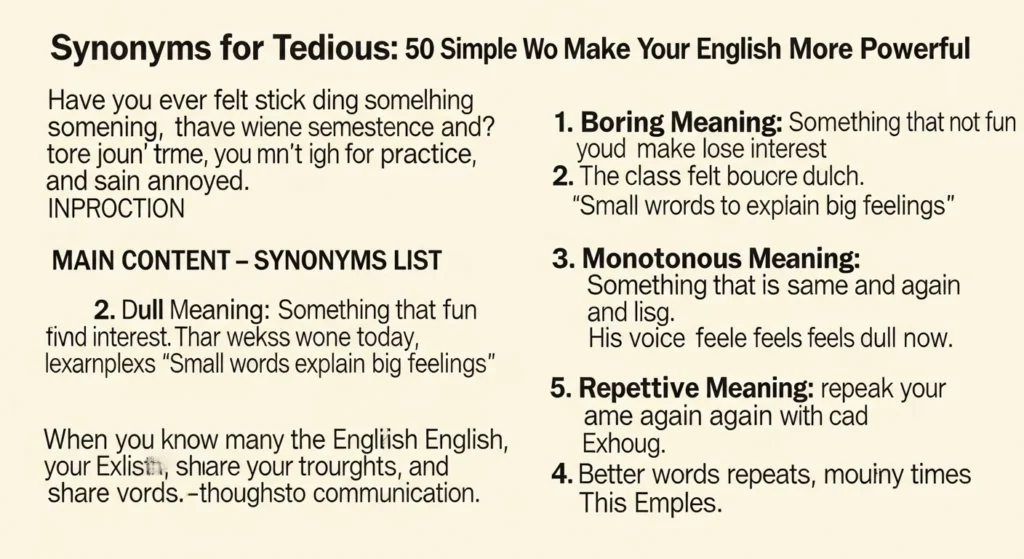
The word tedious means something that is very boring and takes too long. It can make you feel tired or annoyed. This word is simple but very useful. Students can use it in essays. Bloggers and content writers can make their writing richer. Daily English users can express feelings more clearly. Learning synonyms for tedious helps you avoid repeating the same word again and again.
“Small words can explain big feelings.”
When you know many synonyms for tedious, your English becomes stronger and more interesting. You can speak better. You can write better. And you can share your thoughts more clearly with others.
“Better words create better communication.”
MAIN CONTENT – SYNONYMS LIST
1. Boring
Meaning: Something that is not fun and makes you lose interest.
Examples:
- This movie is boring.
- The class felt boring today.
2. Dull
Meaning: Something that is not exciting or lively.
Examples:
- The lecture was dull.
- This game feels dull now.
3. Monotonous
Meaning: Something that is the same again and again.
Examples:
- The job is monotonous.
- His voice sounds monotonous.
4. Repetitive
Meaning: Something that repeats many times.
Examples:
- This task is repetitive.
- The song feels repetitive.
5. Wearisome
Meaning: Something that makes you very tired.
Examples:
- The long walk was wearisome.
- This work is wearisome.
6. Tiresome
Meaning: Something that makes you feel tired and bored.
Examples:
- The talk was tiresome.
- Waiting is tiresome.
7. Draining
Meaning: Something that takes away your energy.
Examples:
- The job is draining.
- This day feels draining.
8. Exhausting
Meaning: Something that makes you very tired.
Examples:
- The trip was exhausting.
- This work is exhausting.
9. Long
Meaning: Something that takes a lot of time.
Examples:
- It was a long meeting.
- The line is long.
10. Slow
Meaning: Something that moves or happens slowly.
Examples:
- The process is slow.
- This day feels slow.
11. Dragging
Meaning: Something that feels like it is taking too long.
Examples:
- The class is dragging.
- Time is dragging today.
12. Annoying
Meaning: Something that makes you feel irritated.
Examples:
- The noise is annoying.
- This task is annoying.
13. Frustrating
Meaning: Something that makes you upset and tired.
Examples:
- The work is frustrating.
- This game is frustrating.
14. Endless
Meaning: Something that feels like it never stops.
Examples:
- The road seems endless.
- The wait is endless.
15. Lengthy
Meaning: Something that is very long.
Examples:
- It was a lengthy talk.
- The book is lengthy.
16. Prolonged
Meaning: Something that lasts longer than expected.
Examples:
- The delay was prolonged.
- The meeting was prolonged.
17. Flat
Meaning: Something that has no excitement.
Examples:
- The story feels flat.
- His speech was flat.
18. Lifeless
Meaning: Something that has no energy.
Examples:
- The room feels lifeless.
- The talk was lifeless.
19. Routine
Meaning: Something done the same way every day.
Examples:
- My routine is boring.
- This work is routine.
20. Mechanical
Meaning: Something done without feeling.
Examples:
- His work is mechanical.
- The task feels mechanical.
21. Plain
Meaning: Something simple and not exciting.
Examples:
- The design is plain.
- The food tastes plain.
22. Ordinary
Meaning: Something common and not special.
Examples:
- It was an ordinary day.
- The show is ordinary.
23. Uninteresting
Meaning: Something that does not catch your attention.
Examples:
- The topic is uninteresting.
- This book is uninteresting.
24. Mind-numbing
Meaning: Something that makes your brain feel tired.
Examples:
- The task is mind-numbing.
- This job feels mind-numbing.
25. Dreary
Meaning: Something that feels sad and boring.
Examples:
- The weather is dreary.
- The place feels dreary.
26. Grim
Meaning: Something that feels dull and serious.
Examples:
- The day feels grim.
- The room looks grim.
“Simple words can paint strong pictures.”
27. Stale
Meaning: Something that feels old and not fresh.
Examples:
- The idea is stale.
- This joke feels stale.
28. Predictable
Meaning: Something easy to guess.
Examples:
- The story is predictable.
- His moves are predictable.
29. Unvaried
Meaning: Something that does not change.
Examples:
- The routine is unvaried.
- The work feels unvaried.
30. Banal
Meaning: Something very common and boring.
Examples:
- The idea is banal.
- His speech was banal.
31. Colorless
Meaning: Something without excitement.
Examples:
- The show is colorless.
- The talk felt colorless.
32. Dry
Meaning: Something not interesting or lively.
Examples:
- The lecture was dry.
- This topic feels dry.
33. Flatline
Meaning: Something with no change or excitement.
Examples:
- The mood feels flatline.
- The energy seems flatline.
34. Heavy
Meaning: Something that feels hard and tiring.
Examples:
- The work is heavy.
- The day feels heavy.
35. Laborious
Meaning: Something that needs a lot of effort.
Examples:
- The task is laborious.
- This work feels laborious.
36. Grueling
Meaning: Something very hard and tiring.
Examples:
- The trip was grueling.
- The job is grueling.
37. Fatiguing
Meaning: Something that makes you tired.
Examples:
- The walk is fatiguing.
- This work is fatiguing.
38. Stressful
Meaning: Something that causes stress.
Examples:
- The job is stressful.
- Exams are stressful.
39. Mindless
Meaning: Something done without thinking.
Examples:
- The task is mindless.
- This job feels mindless.
40. Deadening
Meaning: Something that reduces feeling or interest.
Examples:
- The work is deadening.
- The routine feels deadening.
41. Drab
Meaning: Something dull and not bright.
Examples:
- The room looks drab.
- The day feels drab.
42. Unexciting
Meaning: Something that is not fun.
Examples:
- The event is unexciting.
- The game feels unexciting.
43. Weariful
Meaning: Something that causes boredom.
Examples:
- The task is weariful.
- This day feels weariful.
44. Plodding
Meaning: Something slow and heavy.
Examples:
- The story is plodding.
- The work feels plodding.
45. Draggy
Meaning: Something that feels slow and boring.
Examples:
- The movie is draggy.
- The class feels draggy.
46. Slow-paced
Meaning: Something that moves very slowly.
Examples:
- The show is slow-paced.
- The day feels slow-paced.
47. Recurrent
Meaning: Something that happens again and again.
Examples:
- The task is recurrent.
- The issue is recurrent.
48. Samey
Meaning: Something that feels the same all the time.
Examples:
- The work feels samey.
- The show is the same.
49. Laboring
Meaning: Something that requires hard effort.
Examples:
- The job is laboring.
- The task feels laboring.
50. Dragging-on
Meaning: Something that continues too long.
Examples:
- The meeting is dragging-on.
- The lecture feels dragging-on.
Learning synonyms for tedious can truly change how you use English. When you know more words, your writing becomes richer and clearer. Your ideas sound fresh. You do not repeat the same word again and again. This is very helpful for students, bloggers, and content writers. It also helps in daily speaking.
CONCLUSION
“Practice turns simple words into strong skills.“
When you use different words, people understand you better. Your emails sound more natural. Your essays become interesting. Your conversations feel more alive. Even simple changes can make a big difference in how you express your thoughts.
Learning synonyms for tedious can truly change how you use English. When you know more words, your writing becomes richer and clearer. Your ideas sound fresh. You do not repeat the same word again and again. This is very helpful for students, bloggers, and content writers. It also helps in daily speaking.
When you use different words, people understand you better. Your emails sound more natural. Your essays become more interesting. Your conversations feel more alive. Even simple changes can make a big difference in how you express your thoughts.
Try to practice these words every day. Use them in your school work. Add them to your blog posts. Speak them in daily conversations. Start small and stay consistent. Over time, you will feel more confident using English.
“The right word makes your message shine.”
Keep learning, keep practicing and your English will grow stronger every day.