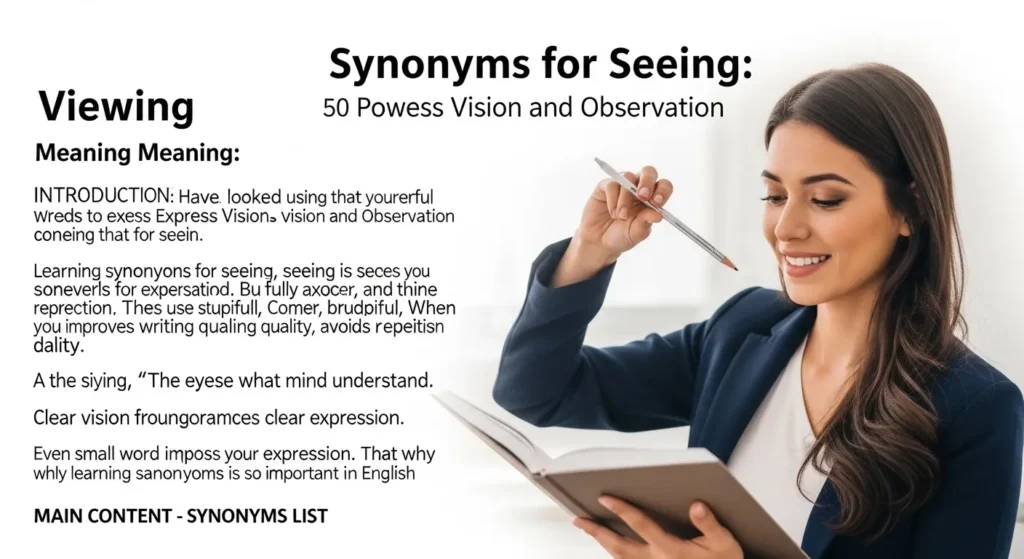

Have you ever looked at something and felt that the word “seeing” was not enough to describe your experience? Maybe you noticed a beautiful sunset, observed a science experiment, or carefully looked at a picture in your book. In all these moments, we use synonyms for seeing to express different ways of looking, noticing, and understanding the world.
For example, when someone watches a movie, they are not just “seeing” it—they are fully experiencing it. When a student notices a small mistake in their notebook, they are carefully observing it. This is where synonyms for seeing become very useful in daily life.
In simple English, “seeing” means using your eyes to look at something or to understand it. But we can also say viewing, observing, or noticing depending on the situation. Learning synonyms for seeing helps you express ideas more clearly and naturally.
As the saying goes, “The eyes see what the mind understands.”
This is helpful for students, bloggers, content writers, teachers, and anyone who uses English in daily life. It improves writing quality and helps avoid repetition.
Another thought is “Clear vision brings clear expression.”
Even small word choices can improve communication. That is why learning synonyms for seeing is very important in English.
MAIN CONTENT – SYNONYMS LIST
Viewing
Meaning: To look at something carefully.
Examples:
- A learner is viewing a painting in a gallery.
- They are viewing photos from their trip.
Observing
Meaning: To watch something with attention.
Examples:
- Students are observing a science experiment.
- A researcher is observing animal behavior.
Watching
Meaning: To look at something happening.
Examples:
- A group is watching a football match.
- They are watching a tutorial video.
Gazing
Meaning: To look at something for a long time.
Examples:
- Someone is gazing at the night sky.
- A person was gazing at the ocean.
Staring
Meaning: To look at something without moving the eyes.
Examples:
- A learner is staring at the screen.
- They were staring at the whiteboard.
Noticing
Meaning: To become aware of something by seeing it.
Examples:
- A student is noticing small details in the text.
- They noticed a change in the design.
Spotting
Meaning: To see something quickly.
Examples:
- A person spotted their friend in the crowd.
- They spotted a mistake in the answer sheet.
Perceiving
Meaning: To understand something through observation.
Examples:
- A learner is perceiving changes in the chart.
- They perceived a difference in tone.
Witnessing
Meaning: To see something happen directly.
Examples:
- A group witnessed the event.
- They witnessed a beautiful ceremony.
Beholding
Meaning: To see something beautiful or impressive.
Examples:
- A visitor is beholding the mountain view.
- They beheld a stunning sunset.
Inspecting
Meaning: To check something carefully.
Examples:
- A teacher is inspecting notebooks.
- They inspected the equipment.
Examining
Meaning: To study something closely.
Examples:
- A learner is examining a diagram.
- They examined the report carefully.
Scanning
Meaning: To look quickly over something.
Examples:
- A student scanned the page for answers.
- They scanned the list of names.
Surveying
Meaning: To look over an area or situation.
Examples:
- A worker is surveying the land.
- They surveyed the classroom.
Looking
Meaning: To direct the eyes toward something.
Examples:
- A learner is looking at the board.
- They looked at the instructions.
Glancing
Meaning: To look quickly.
Examples:
- A student glanced at the clock.
- They glanced at the note.
Peering
Meaning: To look closely or carefully.
Examples:
- A person is peering through the window.
- They peered into the box.
Sighting
Meaning: To see something briefly.
Examples:
- There was a rare bird sighting.
- They reported a sighting of the comet.
Eyeballing
Meaning: To look at something casually.
Examples:
- A shopper is eyeballing the dress.
- They eyeballed the new device.
Checking out
Meaning: To look at something new.
Examples:
- A visitor is checking out the store.
- They checked out the new café.
Reviewing
Meaning: To look at something again carefully.
Examples:
- A student is reviewing notes.
- They reviewed the pictures.
Monitoring
Meaning: To watch regularly over time.
Examples:
- A system is monitoring performance.
- They are monitoring progress.
Studying
Meaning: To look at something deeply.
Examples:
- A learner is studying a map.
- They studied the artwork.
Exploring visually
Meaning: To look around with interest.
Examples:
- A visitor is exploring a museum.
- They explored the gallery visually.
Scrutinizing
Meaning: To examine very carefully.
Examples:
- A teacher is scrutinizing answers.
- They scrutinized the document.
Appraising
Meaning: To judge something by looking at it.
Examples:
- An expert is appraising artwork.
- They appraised the house.
Observing closely
Meaning: To watch with great attention.
Examples:
- A learner is observing the process closely.
- They observed the reaction closely.
Catching sight
Meaning: To suddenly see something.
Examples:
- A person caught sight of a rainbow.
- They caught sight of their friend.
Laying eyes on
Meaning: To see something for the first time.
Examples:
- A visitor laid eyes on the city skyline.
- They laid eyes on the new design.
Taking in
Meaning: To see and understand fully.
Examples:
- A traveler is taking in the scenery.
- They took in the view slowly.
Looking at
Meaning: To direct the eyes toward something.
Examples:
- A learner is looking at the chart.
- They looked at the instructions.
Observation
Meaning: The act of carefully seeing something.
Examples:
- Careful observation is important in science.
- Their observation was accurate.
Visualizing
Meaning: To see something in the mind or imagination.
Examples:
- A learner is visualizing success.
- They visualized the final result.
Detecting
Meaning: To find something by seeing it.
Examples:
- A device is detecting heat.
- They detected an error.
Discerning
Meaning: To see differences clearly.
Examples:
- A learner is discerning details.
- They discerned the pattern.
Viewing over
Meaning: To look across an area.
Examples:
- A person is viewing over the valley.
- They viewed over the city.
Eyeing
Meaning: To look at something with interest.
Examples:
- A shopper is eyeing the product.
- They eyed the prize.
Peeking
Meaning: To look quickly or secretly.
Examples:
- A child is peeking outside.
- They peeked at the gift.
Peering at
Meaning: To look closely at something.
Examples:
- A learner is peering at the screen.
- They peered at the sign.
Watching over
Meaning: To observe or protect carefully.
Examples:
- A caregiver is watching over children.
- They watched over the house.
Sightseeing
Meaning: To visit and look at places.
Examples:
- A group is sightseeing in the city.
- They went sightseeing together.
Perceiving visually
Meaning: To understand by seeing.
Examples:
- A learner is perceiving visual changes.
- They perceived the difference visually.
Taking a look
Meaning: To look at something briefly.
Examples:
- A person took a look inside the room.
- They will take a look later.
Glimpsing
Meaning: To see something for a moment.
Examples:
- A traveler glimpsed the mountains.
- They glimpsed the letter.
Scanning over
Meaning: To look quickly across something.
Examples:
- A learner is scanning over the page.
- They scanned over the list.
Surveying visually
Meaning: To look over something carefully.
Examples:
- A worker is surveying the area visually.
- They surveyed the field visually.
Witnessing firsthand
Meaning: To directly see something happen.
Examples:
- A person witnessed the event firsthand.
- They witnessed the change firsthand.
Looking upon
Meaning: To see something with emotion or feeling.
Examples:
- A person looked upon the scene peacefully.
- They looked upon the view happily.
Noticing closely
Meaning: To become aware of details carefully.
Examples:
- A learner is noticing details closely.
- They noticed the difference closely.
Spotting quickly
Meaning: To identify something fast.
Examples:
- A player is spotting the ball quickly.
- They spotted the mistake quickly.
CONCLUSION
Learning synonyms for seeing helps improve vocabulary, writing, speaking, and communication skills. When you use different words such as observing, gazing, or noticing, your language becomes more natural, expressive, and clear. It also helps avoid repetition in essays, blogs, emails, and daily conversations.
Another idea is “Better words create better understanding.”
For students, it improves exam writing skills. For bloggers and writers, it makes content more engaging and professional. For everyday English users, it helps express thoughts more accurately and confidently.
As we often say, “What we see shapes what we say.”
Practice these synonyms in real life. Use them in writing tasks, conversations, and storytelling. The more you use them, the stronger your English becomes.