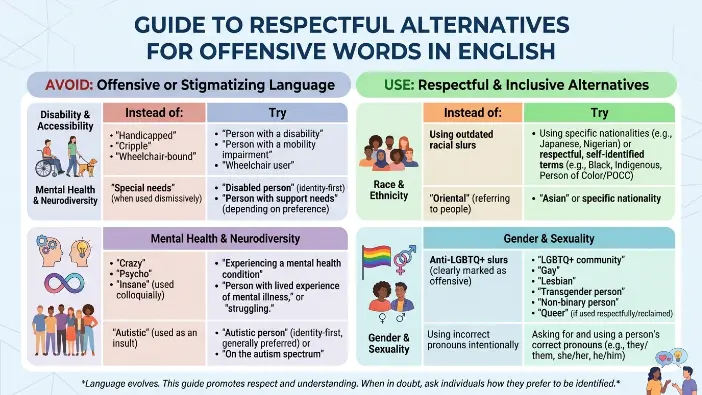

Words have power. A single word can make someone feel respected, supported, or deeply hurt. Many terms that were once common in old conversations are now considered offensive because they insult people or disabilities. That is why modern English encourages the use of respectful and thoughtful alternatives in daily communication.
For example, if someone makes a poor decision, it is kinder to say the idea was foolish or irrational instead of using harmful language. In schools, workplaces, social media, and conversations, respectful vocabulary creates a safer and more positive environment for everyone.
“Good communication begins with thoughtful word choices.
”In simple English, some older words were used to describe slow progress or learning difficulties. Over time, these terms became insulting. Today, people prefer modern alternatives such as uninformed, ignorant, foolish, irrational, insensitive, or confused depending on the meaning and situation. Learning respectful synonyms improves communication and helps people speak more politely and professionally.
“Kind language reflects a respectful mind.”
Students, bloggers, content writers, and daily English users all benefit from learning modern and respectful vocabulary. It improves writing quality and creates better human connections.
Literal Meaning
In older English, some terms were used to describe delayed movement or slower progress. Today, people use softer and more respectful words like delayed, slowed, hindered, or stalled.
These alternatives sound clearer and more professional in modern communication.
- Delayed means happening later than expected
- Slowed means moving less quickly
- Hindered means progress was blocked
Clinical & Respectful Alternative
In medical and educational settings, respectful terms are very important. Professionals now use phrases like developmental delay, learning disability, or intellectual disability instead of outdated language.
These terms focus on support, understanding, and care instead of judgment.
- Developmental delay is medically respectful
- Learning disability is common in schools
- Intellectual disability is used professionally
Informal Alternatives
When describing a poor idea or unreasonable action, modern English uses words like foolish, irrational, absurd, silly, or unreasonable.
These alternatives describe behavior without insulting people.
- Foolish means lacking good judgment
- Irrational means not based on logic
- Silly sounds casual and light
🔷 COMPARISON TABLE
| Keyword | Meaning | Usage Type | Context |
|---|---|---|---|
| Literal Meaning | Slowed or delayed progress | Formal | Science, old writing |
| Clinical & Respectful Alternative | Respectful support-focused terms | Professional | Healthcare, education |
| Informal Alternatives | Words for poor decisions or actions | Casual | Daily communication |
MAIN CONTENT – SYNONYMS LIST
1. Uninformed
Meaning:
Not having enough knowledge about something.
Examples:
- He sounded uninformed during the discussion.
- The article left readers uninformed.
2. Ignorant
Meaning:
Not knowing important facts or information.
Examples:
- She was ignorant about the rules.
- His comment seemed ignorant.
3. Foolish
Meaning:
Showing poor judgment or thinking.
Examples:
- That was a foolish choice.
- He made a foolish mistake.
4. Irrational
Meaning:
Not based on clear thinking or logic.
Examples:
- Her fear seemed irrational.
- The decision felt irrational.
5. Insensitive
Meaning:
Not caring about other people’s feelings.
Examples:
- His joke sounded insensitive.
- She made an insensitive comment.
6. Silly
Meaning:
Lacking seriousness or good sense.
Examples:
- That idea sounds silly.
- He made a silly face.
7. Absurd
Meaning:
Very unreasonable or strange.
Examples:
- The excuse was absurd.
- She laughed at the absurd claim.
8. Unreasonable
Meaning:
Not fair or sensible.
Examples:
- The demand was unreasonable.
- He became unreasonable during the argument.
9. Confused
Meaning:
Unable to understand something clearly.
Examples:
- She looked confused in class.
- The directions confused him.
10. Misguided
Meaning:
Led in the wrong direction or belief.
Examples:
- His actions were misguided.
- She followed misguided advice.
11. Thoughtless
Meaning:
Not thinking carefully about others.
Examples:
- That was a thoughtless remark.
- He made a thoughtless decision.
12. Careless
Meaning:
Not paying enough attention.
Examples:
- The mistake was careless.
- She sounded careless today.
13. Reckless
Meaning:
Ignoring danger or consequences.
Examples:
- Reckless driving is risky.
- He made reckless choices.
14. Clueless
Meaning:
Not understanding what is happening.
Examples:
- He looked completely clueless.
- She felt clueless during the meeting.
15. Naive
Meaning:
Too trusting or inexperienced.
Examples:
- He sounded naive sometimes.
- Her idea was naive.
16. Childish
Meaning:
Acting immaturely.
Examples:
- His behavior was childish.
- Stop making childish jokes.
17. Immature
Meaning:
Not emotionally developed.
Examples:
- The response seemed immature.
- She acted immature yesterday.
18. Dense
Meaning:
Slow to understand something.
Examples:
- He felt dense during math class.
- The joke made him seem dense.
19. Slow
Meaning:
Taking more time than usual.
Examples:
- The internet feels slow today.
- He is slow at reading.
20. Delayed
Meaning:
Happening later than expected.
Examples:
- The train was delayed again.
- Her reply was delayed.
21. Hindered
Meaning:
Prevented from moving forward easily.
Examples:
- Rain hindered the game.
- Fear hindered his growth.
22. Stalled
Meaning:
Stopped from making progress.
Examples:
- The project stalled suddenly.
- Talks stalled overnight.
23. Sluggish
Meaning:
Moving slowly without energy.
Examples:
- The system felt sluggish.
- He looked sluggish this morning.
24. Weak
Meaning:
Not strong or powerful.
Examples:
- The signal became weak.
- She felt weak after running.
25. Passive
Meaning:
Not taking active action.
Examples:
- He remained passive during class.
- Her attitude seemed passive.
26. Inefficient
Meaning:
Not working in the best way.
Examples:
- The process was inefficient.
- His method seemed inefficient.
27. Unproductive
Meaning:
Not giving useful results.
Examples:
- The meeting felt unproductive.
- He had an unproductive day.
28. Illogical
Meaning:
Not making clear sense.
Examples:
- The argument sounded illogical.
- Her answer seemed illogical.
29. Nonsensical
Meaning:
Without clear meaning or logic.
Examples:
- The statement was nonsensical.
- He gave a nonsensical reply.
30. Ridiculous
Meaning:
Very unreasonable or silly.
Examples:
- The excuse sounded ridiculous.
- Prices became ridiculous recently.
31. Clumsy
Meaning:
Awkward in movement or action.
Examples:
- He is clumsy sometimes.
- She dropped the glass clumsily.
32. Awkward
Meaning:
Not smooth or comfortable.
Examples:
- The silence felt awkward.
- He gave an awkward smile.
33. Dull
Meaning:
Not exciting or bright.
Examples:
- The lecture felt dull.
- Her mood looked dull.
34. Behind
Meaning:
Not moving as fast as others.
Examples:
- He fell behind in school.
- The work is behind schedule.
35. Restricted
Meaning:
Limited by rules or conditions.
Examples:
- Access is restricted here.
- The road became restricted.
36. Limited
Meaning:
Not large or complete.
Examples:
- We have limited time today.
- The service is limited now.
37. Challenged
Meaning:
Facing difficulty in some area.
Examples:
- He felt academically challenged.
- She is physically challenged.
38. Struggling
Meaning:
Having difficulty doing something.
Examples:
- He is struggling in math.
- She struggled with reading.
39. Impaired
Meaning:
Not functioning fully or properly.
Examples:
- His vision is impaired.
- The device became impaired.
40. Obstructed
Meaning:
Blocked from moving freely.
Examples:
- The road was obstructed.
- Trees obstructed the view.
41. Slowed
Meaning:
Moving at a lower speed.
Examples:
- Traffic slowed near the bridge.
- The machine slowed suddenly.
42. Set Back
Meaning:
Forced backward in progress.
Examples:
- Illness set back his plans.
- The storm set back construction.
43. Discouraged
Meaning:
Feeling less hopeful or confident.
Examples:
- She felt discouraged today.
- Failure discouraged him deeply.
44. Emotionally Unaware
Meaning:
Not understanding emotional situations well.
Examples:
- He seemed emotionally unaware.
- Her response felt emotionally unaware.
45. Inconsiderate
Meaning:
Not caring about others properly.
Examples:
- That comment was inconsiderate.
- He sounded inconsiderate yesterday.
46. Unthinking
Meaning:
Acting without careful thought.
Examples:
- It was an unthinking mistake.
- She gave an unthinking reply.
47. Foolhardy
Meaning:
Taking dangerous risks carelessly.
Examples:
- His plan sounded foolhardy.
- She made a foolhardy decision.
48. Dim-Witted
Meaning:
Slow at understanding things.
Examples:
- The character seemed dim-witted.
- He acted dim-witted jokingly.
49. Slow-Minded
Meaning:
Understanding things more slowly.
Examples:
- The child is slow-minded.
- Teachers gave patient guidance.
50. Mentally Challenged
Meaning:
Having intellectual difficulties.
Examples:
- The center supports mentally challenged people.
- Schools provide extra help.
CONCLUSION
Learning respectful alternatives and modern synonyms improves communication, writing, blogging, speaking, and daily conversations. Thoughtful vocabulary helps people express ideas clearly without hurting others. Modern English encourages respectful and inclusive language because words strongly affect emotions and relationships.
“Good vocabulary is not only smart but also respectful.”
Students can improve their vocabulary and communication skills by learning better word choices. Bloggers and content writers can create more professional and respectful content. Daily English users also sound more mature and thoughtful when using modern alternatives instead of offensive expressions.
“Respectful communication builds stronger human connections.”
Practice these words in essays, emails, social media posts, and daily conversations. Over time, respectful language becomes a natural habit that improves both communication and relationships.