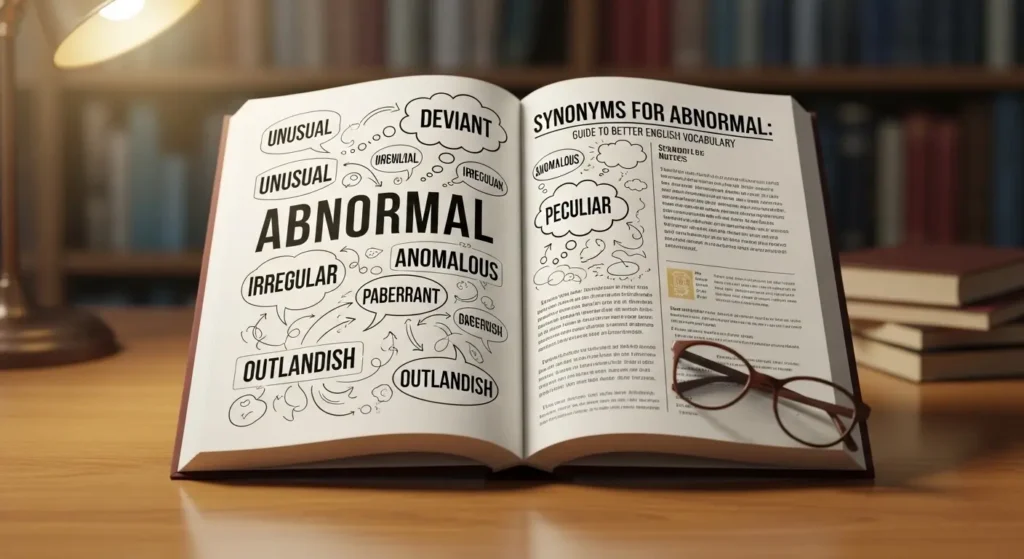

Have you ever noticed something that feels different from what you usually see and struggled to describe it in a better way? Maybe a student behaves in an unexpected manner or the weather suddenly changes without reason. In such moments, we often use the word abnormal, but sometimes it feels too simple or repeated. That is where learning synonyms for abnormal becomes very helpful in English writing and speaking.
For example, if a machine suddenly stops working in a strange way, you might call it abnormal. But there are many better words you can use to explain the situation more clearly and naturally. Understanding synonyms for abnormal helps you express ideas in different ways without repeating the same word again and again.
“Good words make simple ideas powerful.”
In simple English, abnormal means something that is not normal or not usual. These words are very useful for students, bloggers, content writers and daily English users. They help improve essays, make writing more attractive and make communication clearer and more professional.
“Strong vocabulary builds strong communication.”
When you learn synonyms for abnormal, you improve your ability to describe people, things and situations in a more creative way. It also helps in exams, blogs and everyday conversations where a variety of language matters.
MAIN CONTENT – 50 SYNONYMS FOR ABNORMAL
1. Unusual
Examples:
The noise was unusual at night.
He showed unusual behavior today.
Meaning: Not common or different from normal.
2. Odd
Examples:
That is an odd reply.
She noticed an odd smell.
Meaning: Something that feels strange or not normal.
3. Strange
Examples:
It was a strange place.
He gave a strange look.
Meaning: Not familiar or different from usual.
4. Weird
Examples:
That was a weird sound.
I had a weird dream.
Meaning: Very different in a surprising way.
5. Irregular
Examples:
His heartbeat is irregular.
The shape is irregular.
Meaning: Not following a fixed pattern.
6. Atypical
Examples:
This is an atypical case.
Her answer was atypical.
Meaning: Not typical or not normal.
7. Anomalous
Examples:
The result is anomalous.
It was an anomalous reading.
Meaning: Different from normal rules or patterns.
8. Aberrant
Examples:
His actions are aberrant.
The cells showed aberrant growth.
Meaning: Moving away from normal behavior.
9. Freakish
Examples:
The weather is freakish.
He has freakish strength.
Meaning: Very strange or unusual.
10. Peculiar
Examples:
She has a peculiar voice.
That plant looks peculiar.
Meaning: Slightly strange but noticeable.
11. Bizarre
Examples:
It was a bizarre story.
He wore a bizarre outfit.
Meaning: Very strange and shocking.
12. Uncommon
Examples:
Snow is uncommon here.
That bird is uncommon.
Meaning: Not seen often.
13. Rare
Examples:
It is a rare event.
He owns a rare book.
Meaning: Happens very little.
14. Eccentric
Examples:
He is an eccentric man.
She has eccentric habits.
Meaning: Behaving in a very different way.
15. Unconventional
Examples:
His ideas are unconventional.
She chose an unconventional path.
Meaning: Not following usual methods.
16. Deviant
Examples:
The result is deviant.
His act was deviant.
Meaning: Different from accepted behavior.
17. Unnatural
Examples:
That smile looks unnatural.
The sound feels unnatural.
Meaning: Not feeling natural or normal.
18. Offbeat
Examples:
She likes offbeat music.
It is an offbeat idea.
Meaning: Unusual and different style.
19. Extraordinary
Examples:
It was an extraordinary moment.
He has extraordinary skills.
Meaning: Very special and unusual.
20. Exceptional
Examples:
She gave an exceptional answer.
It was an exceptional day.
Meaning: Better or different from normal.
21. Infrequent
Examples:
His visits are infrequent.
Rain is infrequent here.
Meaning: Not happening often.
22. Nonstandard
Examples:
This is a nonstandard method.
They used nonstandard format.
Meaning: Not following normal rules.
23. Divergent
Examples:
Their ideas are divergent.
The paths are divergent.
Meaning: Moving in different directions.
24. Outlandish
Examples:
That is an outlandish claim.
He wore outlandish clothes.
Meaning: Very strange or unbelievable.
25. Idiosyncratic
Examples:
His writing is idiosyncratic.
She has idiosyncratic habits.
Meaning: Very personal and different style.
26. Quirky
Examples:
She has a quirky smile.
That is a quirky idea.
Meaning: Funny and slightly strange.
27. Singular
Examples:
It is a singular case.
He has singular talent.
Meaning: Unique and different from others.
28. Anomalistic
Examples:
The data is anomalistic.
It shows anomalistic behavior.
Meaning: Related to unusual changes.
29. Unorthodox
Examples:
He uses unorthodox methods.
Her approach is unorthodox.
Meaning: Not following traditional rules.
30. Malformed
Examples:
The file is malformed.
It is a malformed structure.
Meaning: Not shaped correctly.
31. Distorted
Examples:
The image is distorted.
His voice sounded distorted.
Meaning: Changed from original form.
32. Skewed
Examples:
The data is skewed.
His opinion is skewed.
Meaning: Not balanced or correct.
33. Twisted
Examples:
The metal is twisted.
He told a twisted story.
Meaning: Bent or changed form.
34. Crooked
Examples:
The road is crooked.
That is a crooked line.
Meaning: Not straight or correct.
35. Awkward
Examples:
It was an awkward moment.
He gave an awkward smile.
Meaning: Uncomfortable or not smooth.
36. Freaky
Examples:
That sound is freaky.
It was a freaky story.
Meaning: Very strange or scary.
37. Nonconforming
Examples:
He is nonconforming.
It is a nonconforming style.
Meaning: Not following rules.
38. Outlier
Examples:
This is an outlier result.
He is an outlier student.
Meaning: Very different from others in a group.
39. Unexpected
Examples:
It was unexpected.
She gave an unexpected answer.
Meaning: Not planned or guessed.
40. Surreal
Examples:
The scene felt surreal.
It was a surreal moment.
Meaning: Dream-like and unreal.
41. Alien
Examples:
The idea feels alien.
The place looked alien.
Meaning: Very unfamiliar or strange.
42. Monstrous
Examples:
It is a monstrous structure.
He has monstrous power.
Meaning: Very large or strange.
43. Deformed
Examples:
The object is deformed.
The tree looks deformed.
Meaning: Not shaped normally.
44. Defective
Examples:
The device is defective.
It is a defective part.
Meaning: Not working properly.
45. Aberrated
Examples:
The signal is aberrated.
It is an aberrated pattern.
Meaning: Moved away from normal form.
46. Off-kilter
Examples:
The picture is off-kilter.
His mood feels off-kilter.
Meaning: Slightly unbalanced.
47. Non-normal
Examples:
The reading is non-normal.
It is a non-normal case.
Meaning: Not in normal condition.
48. Unwonted
Examples:
He showed unwonted kindness.
It was unwonted behavior.
Meaning: Not usual or expected.
49. Nonconventional
Examples:
She used nonconventional ideas.
It is a nonconventional plan.
Meaning: Not following common methods.
50. Aberrated
Examples:
The pattern is aberrated.
The signal is aberrated.
Meaning: Shifted away from normal form.
CONCLUSION
Learning synonyms for abnormal is one of the best ways to improve your English vocabulary. When you know many different words with similar meanings, your writing becomes richer and more expressive. It helps you avoid repetition and makes your communication more natural and professional.
“Practice turns knowledge into skill.”
Students can use these words in exams to write better answers. Bloggers and writers can make their content more engaging and SEO-friendly. Daily English learners can speak more confidently by using varied vocabulary in conversations.
“Good words open the door to better communication.”
Practicing these words regularly is very important. Try using them in essays, emails and daily speech. The more you use them, the easier they become. Slowly, your vocabulary will grow and your English will sound more natural.
“A strong vocabulary creates strong expression.”