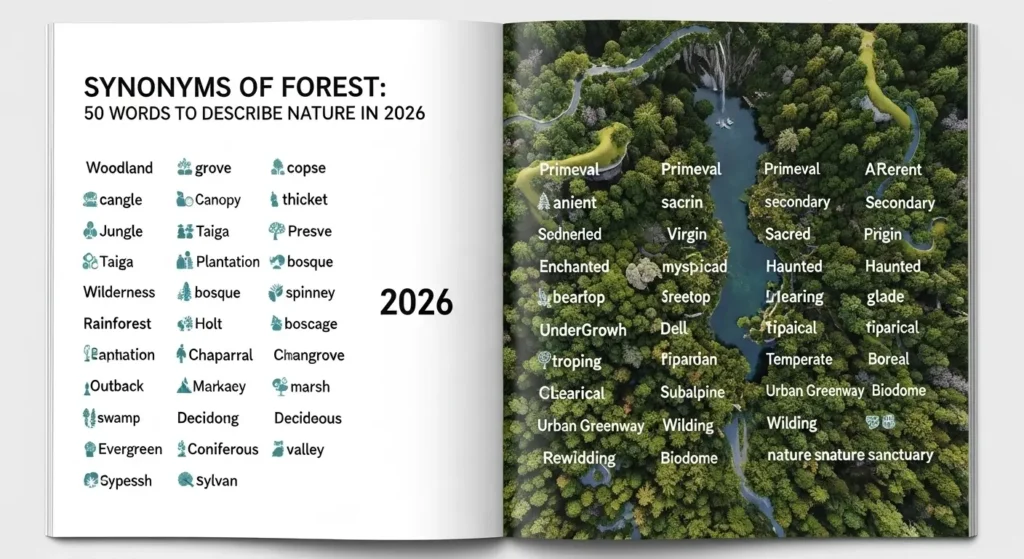

Have you ever walked through a place full of tall trees, birds, and fresh air? Many people call this place a forest. But did you know there are many other words that mean almost the same thing? Learning the synonyms of forest can help you describe nature in a richer and more interesting way.
For example, a student writing a story may want to describe a dark forest. Instead of repeating the same word again and again, they can use words like woods, jungle, or woodland. These words help make writing more colorful and clear.
“Nature speaks through the quiet language of trees.”
A forest is a large area filled with many trees, plants, and animals. It is a place where nature grows freely. Forests are important for the earth because they give us oxygen, shelter for animals, and beauty for people to enjoy.
Knowing the synonyms of forest is useful for students, bloggers, and writers. It helps avoid repeating the same word many times. It also makes stories, essays, and blog posts sound more natural and engaging.
“A forest is not just trees, it is a world of life.”
Even in daily English conversations, these words help people describe nature better. When you learn the synonyms of forest, your vocabulary grows and your writing becomes stronger.
Now let’s explore 50 useful words related to the word forest.
Woods
Meaning:
A place with many trees.
Examples:
- We walked through the woods.
- The woods were quiet today.
Woodland
Meaning:
Land covered with trees.
Examples:
- The deer ran into the woodland.
- The woodland looks beautiful.
Jungle
Meaning:
A very thick forest in hot places.
Examples:
- Tigers live in the jungle.
- The jungle is full of life.
Grove
Meaning:
A small group of trees.
Examples:
- We rested in the grove.
- The grove was cool and calm.
Thicket
Meaning:
A place with thick bushes and trees.
Examples:
- The rabbit hid in the thicket.
- The thicket was hard to walk through.
Copse
Meaning:
A small area of trees.
Examples:
- Birds were singing in the corpses.
- The copse stood near the field.
Timberland
Meaning:
Land covered with trees used for wood.
Examples:
- The workers went to the timberland.
- Timberland spreads across the hills.
Rainforest
Meaning:
A forest with heavy rain.
Examples:
- The rainforest has many animals.
- We learned about the Amazon rainforest.
Bush
Meaning:
Wild land with trees and plants.
Examples:
- Kangaroos live in the bush.
- The bush looked green after the rain.
Wildwood
Meaning:
A natural forest that is not controlled.
Examples:
- The path led to the wildwood.
- The wildwood felt mysterious.
Timber
Meaning:
A forest area used for wood.
Examples:
- The timber area is protected.
- Workers manage the timber forest.
Greenbelt
Meaning:
A natural area with trees around a city.
Examples:
- The city has a greenbelt.
- Families walk in the greenbelt.
Woodland Area
Meaning:
A place filled with trees.
Examples:
- The woodland area is peaceful.
- Birds live in the woodland area.
Forestland
Meaning:
Land covered by forests.
Examples:
- The forestland is protected.
- Many animals live in forestland.
Tree Land
Meaning:
Land full of trees.
Examples:
- The tree land looks beautiful.
- Children explored the tree land.
“In every walk with nature, we receive more than we seek.”
Woodlot
Meaning:
A small forest area.
Examples:
- The farmer owns a woodlot.
- The woodlot has tall trees.
Evergreen Forest
Meaning:
A forest with trees that stay green all year.
Examples:
- The evergreen forest looks fresh.
- Snow fell in the evergreen forest.
Pine Forest
Meaning:
A forest mainly with pine trees.
Examples:
- The pine forest smells nice.
- Birds live in the pine forest.
Oak Forest
Meaning:
A forest with many oak trees.
Examples:
- The oak forest is very old.
- We walked through the oak forest.
Bamboo Forest
Meaning:
A forest full of bamboo plants.
Examples:
- Pandas live in bamboo forests.
- The bamboo forest was quiet.
Mangrove
Meaning:
A forest growing near salty water.
Examples:
- Fish live near the mangrove.
- The mangrove protects the coast.
Woodland Park
Meaning:
A forest-like park.
Examples:
- Families visit the woodland park.
- The woodland park is peaceful.
Natural Reserve
Meaning:
A protected natural forest area.
Examples:
- The reserve protects wildlife.
- We visited a natural reserve.
Wildlife Forest
Meaning:
A forest where animals live safely.
Examples:
- The wildlife forest is protected.
- Many birds live there.
Dense Forest
Meaning:
A forest with many thick trees.
Examples:
- The dense forest looked dark.
- We walked through the dense forest.
Thick Woods
Meaning:
A forest with very close trees.
Examples:
- The thick woods were quiet.
- Animals hid in the thick woods.
Dark Forest
Meaning:
A forest with little sunlight.
Examples:
- The dark forest felt scary.
- The path led into the dark forest.
Green Forest
Meaning:
A healthy forest full of plants.
Examples:
- The green forest looked alive.
- Rain made the forest greener.
Old Forest
Meaning:
A forest that has existed for many years.
Examples:
- The old forest has tall trees.
- Many birds live there.
Deep Woods
Meaning:
The far inner part of a forest.
Examples:
- The cabin stood in deep woods.
- Few people go to deep woods.
Leafy Forest
Meaning:
A forest full of leaves and plants.
Examples:
- The leafy forest was cool.
- Sunlight passed through leaves.
Tree Wilderness
Meaning:
A wild area full of trees.
Examples:
- The tree wilderness is untouched.
- Few people visit it.
Jungle Forest
Meaning:
A thick tropical forest.
Examples:
- Monkeys live in the jungle forest.
- The jungle forest is noisy.
Tropical Forest
Meaning:
A forest in warm regions.
Examples:
- The tropical forest has colorful birds.
- Many plants grow there.
Mountain Forest
Meaning:
A forest on mountains.
Examples:
- The mountain forest was cold.
- Pine trees grow there.
Valley Forest
Meaning:
A forest in a valley.
Examples:
- The valley forest looked beautiful.
- A river passed through it.
River Forest
Meaning:
A forest near a river.
Examples:
- The river forest was green.
- Birds lived near the water.
Hill Forest
Meaning:
A forest on hills.
Examples:
- The hill forest had tall trees.
- We hiked there.
National Forest
Meaning:
A forest protected by the government.
Examples:
- The national forest is huge.
- Many tourists visit it.
Wildlife Park
Meaning:
A protected forest area for animals.
Examples:
- The wildlife park protects animals.
- We saw deer there.
Nature Forest
Meaning:
A forest kept natural.
Examples:
- The nature forest is peaceful.
- People come to relax.
Green Woods
Meaning:
A healthy forest with many plants.
Examples:
- The green woods looked fresh.
- Rain helped the green woods grow.
Thick Jungle
Meaning:
A very dense jungle forest.
Examples:
- The thick jungle was hard to cross.
- Many animals live there.
Rainy Forest
Meaning:
A forest that gets a lot of rain.
Examples:
- The rainy forest stays green.
- Many plants grow there.
Tree Valley
Meaning:
A valley filled with trees.
Examples:
- The tree valley looked magical.
- Birds filled the tree valley.
Woodland Hills
Meaning:
Hills covered with trees.
Examples:
- The woodland hills were quiet.
- The view from there was amazing.
Nature Woods
Meaning:
A natural forest area.
Examples:
- The nature woods are protected.
- Families visit for walks.
Deep Jungle
Meaning:
The inner area of a jungle.
Examples:
- The deep jungle was mysterious.
- Few people travel there.
Tree Reserve
Meaning:
A protected forest area.
Examples:
- The tree reserve saves nature.
- Rangers guard the reserve.
Forest Region
Meaning:
A large area full of forests.
Examples:
- The forest region has many animals.
- Rain falls often there.
Conclusion
Learning new vocabulary helps you describe the world more clearly. When you understand different synonyms of forest, your writing becomes richer and more interesting. Instead of repeating the same word many times, you can choose different words that better describe the place you are talking about
.“A forest is not just trees, it is a world of life.”
Students can use these words in school essays and stories. Bloggers and content writers can use them to make articles more engaging and SEO-friendly. Even in daily conversations, these words help people describe nature in a better way.
For example, you may use woods in casual talk, jungle when speaking about tropical areas, or grove when describing a small group of trees. Choosing the right word helps your message become clearer and more vivid.
“Those who learn the language of nature understand life better.”
The best way to remember these synonyms of forest is practice. Try using them when writing stories, essays, blog posts, or even social media captions about nature.
The more words you learn, the more powerful your communication becomes.