
You are in a classroom. The teacher asks you to explain a topic in a few lines. You think for a moment and give a short answer. The teacher smiles and says, “Good, keep it brief.” Many of us face moments like this every day. We need to say something quickly and clearly without using too many words.
A simple real-life example is when you send a quick message to a friend. You do not write a long story. You just say what is needed. That is where the idea of synonyms of brief becomes useful. It helps you express the same idea in many ways.
“Brevity is the soul of wit.”
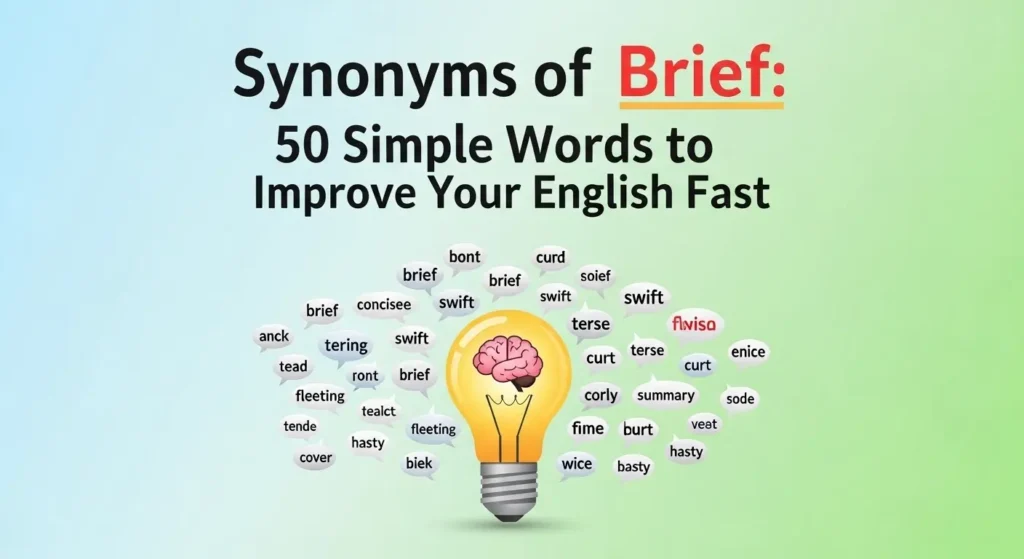
The word brief means short and simple. It means not long. It means using only a few words to say something clear. This word is very helpful for students, bloggers, content writers and daily English users. It helps you write better answers, make clear posts and speak in a smart way.
When you learn synonyms of brief you get more word power. You can avoid repeating the same word again and again. This makes your English sound natural and fresh.
“Say more with fewer words.”
MAIN CONTENT – SYNONYMS LIST
Short
Meaning: Something that does not take much time or space.
Examples:
- Keep your answer short.
- The meeting was short.
Concise
Meaning: Saying something clearly in few words.
Examples:
- Give a concise reply.
- Her message was concise.
Quick
Meaning: Done in a short time.
Examples:
- I gave a quick answer.
- It was a quick chat.
Terse
Meaning: Very short and a bit sharp.
Examples:
- His reply was terse.
- She gave a terse comment.
Compact
Meaning: Small but complete.
Examples:
- The book is compact.
- It is a compact note.
Summary
Meaning: A short form of something long.
Examples:
- I wrote a summary.
- The summary is clear.
Capsule
Meaning: A very short version.
Examples:
- Give a capsule review.
- It is a capsule note.
Snap
Meaning: Very fast and short.
Examples:
- It was a snap reply.
- He made a snap call.
Rapid
Meaning: Very fast.
Examples:
- She gave a rapid answer.
- It was a rapid talk.
Swift
Meaning: Done quickly.
Examples:
- He gave a swift reply.
- It was a swift move.
Mini
Meaning: Very small in size.
Examples:
- It is a mini story.
- I wrote a mini note.
Tiny
Meaning: Very small.
Examples:
- It is a tiny message.
- He gave a tiny reply.
Little
Meaning: Small in amount.
Examples:
- Give a little detail.
- It was a little talk.
Limited
Meaning: Not much.
Examples:
- Time is limited.
- Keep it limited.
Short-lived
Meaning: Lasts a small time.
Examples:
- The joy was short-lived.
- It was a short-lived event.
Briefly
Meaning: For a short time.
Examples:
- Speak briefly.
- He talked briefly.
Crisp
Meaning: Clear and short.
Examples:
- Give a crisp answer.
- It was a crisp line.
Neat
Meaning: Simple and clear.
Examples:
- Write a neat note.
- Keep it neat.
Clear-cut
Meaning: Very clear and short.
Examples:
- It is clear-cut.
- Give a clear-cut answer.
Plain
Meaning: Simple and short.
Examples:
- Use plain words.
- It was plain talk.
Direct
Meaning: Straight and short.
Examples:
- Be direct.
- He gave a direct answer.
To the point
Meaning: Saying only what is needed.
Examples:
- Be to the point.
- Her reply was to the point.
Pithy
Meaning: Short but full of meaning.
Examples:
- It was a pithy line.
- He gave a pithy reply.
Succinct
Meaning: Very clear and short.
Examples:
- Write a succinct note.
- His words were succinct.
Summary-like
Meaning: Like a short form.
Examples:
- It is summary-like.
- She gave a summary-like answer.
Sketchy
Meaning: Giving only basic details.
Examples:
- The note is sketchy.
- He gave a sketchy idea.
Abbreviated
Meaning: Made shorter.
Examples:
- It is an abbreviated form.
- Use abbreviated words.
Reduced
Meaning: Made smaller.
Examples:
- The text is reduced.
- Keep it reduced.
Condensed
Meaning: Made shorter but full.
Examples:
- It is condensed.
- The book is condensed.
Cut
Meaning: Made shorter by removing parts.
Examples:
- The text is cut.
- Cut extra words.
Trim
Meaning: Made neat and short.
Examples:
- Trim the text.
- Keep it trim.
Clipped
Meaning: Spoken or written shortly.
Examples:
- He used clipped words.
- It was clipped speech.
Briefish
Meaning: Somewhat short.
Examples:
- It is briefish.
- The talk was briefish.
Shortened
Meaning: Made shorter.
Examples:
- The text is shortened.
- I shortened my answer.
Small
Meaning: Not big.
Examples:
- It is a small note.
- Give a small answer.
Limited-time
Meaning: For a short time only.
Examples:
- It is limited-time.
- Offer is limited-time.
Momentary
Meaning: Lasts for a moment.
Examples:
- It was momentary.
- A momentary pause came.
Fleeting
Meaning: Very quick and short.
Examples:
- A fleeting thought came.
- It was fleeting joy.
Quickie
Meaning: Very short action.
Examples:
- It was a quickie talk.
- We had a quickie chat.
Snappy
Meaning: Short and lively.
Examples:
- Give a snappy line.
- It was snappy speech.
Compacted
Meaning: Pressed into less space.
Examples:
- It is compacted.
- The text is compacted.
Simple
Meaning: Easy and short.
Examples:
- Keep it simple.
- It is simple talk.
Basic
Meaning: Only main points.
Examples:
- Give basic info.
- It was basic detail.
Light
Meaning: Not heavy or long.
Examples:
- It was light talk.
- Keep it light.
Minimal
Meaning: Very small amount.
Examples:
- Use minimal words.
- It was minimal text.
Quick-fire
Meaning: Very fast and short.
Examples:
- It was quick-fire.
- He gave quick-fire answers.
Brief-note
Meaning: A short written message.
Examples:
- I sent a brief-note.
- She wrote a brief-note.
Fast
Meaning: Done quickly.
Examples:
- It was fast.
- He gave a fast reply.
Short-form
Meaning: A shorter version.
Examples:
- It is short-form.
- Use short-form writing.
Quick-summary
Meaning: A short explanation.
Examples:
- Give a quick-summary.
- I made a quick-summary.
CONCLUSION
Learning synonyms of brief can truly change the way you use English. When you know many words for one idea you can write better blogs, create strong content and express yourself clearly. It also helps you avoid repeating the same word again and again which makes your language sound fresh and natural.
“Small words can carry big meanings.”
For students it improves answers. For bloggers it makes posts more engaging. For daily users it helps in clear communication. You can use these words in emails, essays and daily conversations. Start small. Try one or two new words every day.
“Practice makes simple words powerful.”
Keep using these synonyms in real life. Over time you will feel more confident and fluent in English.
“Great communication starts with simple words.”